
Despite rapidly growing fears about AI safety, the prior weeks have brought us two of the least consequential—and most performative—summits in memory: President Trump’s lovefest with Chinese General Secretary Xi, and Trump’s “morally binding” pinky-swear agreement with hyperscaler CEOs. The two meetings have clarified one issue, however: President Donald Trump really, really wants us to use the term “super intelligence” to refer to AI.
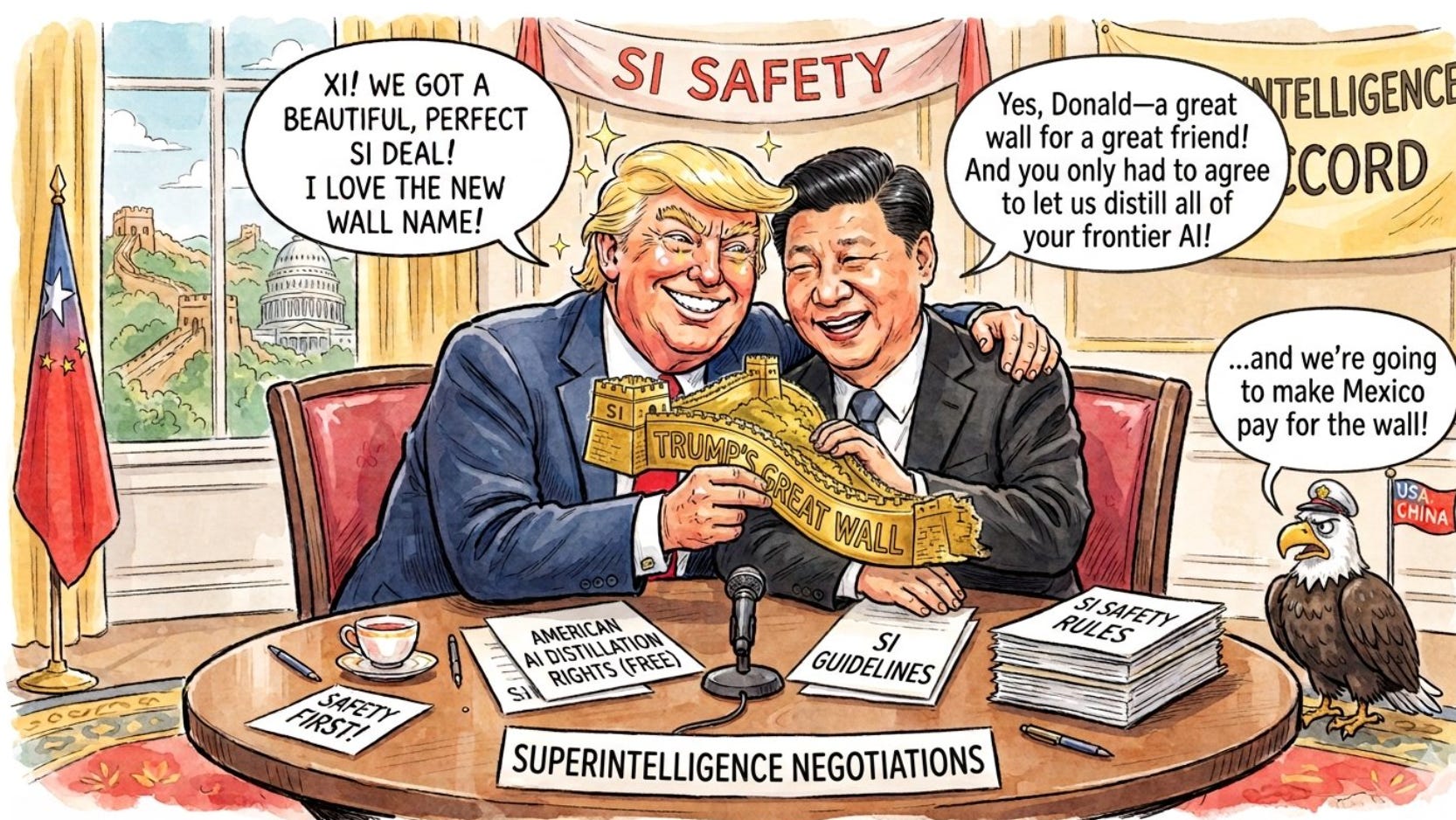
We can rest assured that “morally binding” agreements will be enforced with the same force as regulation over office potluck sign-up sheets.
Prior to the Xi-Trump meeting, I discussed on several national news outlets the bipartisan legislation I am introducing with U.S. Rep. Kevin Kiley (CA-3) to spur progress with the People’s Republic of China on AI safety. Unlike other colleagues’ proposals—seeking a “grand agreement” with the Chinese on pacing or prohibiting recursive self-improvement—our legislation focuses where progress seems more immediately achievable: in unofficial, non-governmental “Track II” diplomacy.
That is, before we can accomplish anything at the negotiating table, AI safety experts in both countries must reach a common understanding about very technical issues. American and Chinese AI scientists need to understand how the other nation’s experts measure model capabilities, identify optimal methods for testing and assessment, and, perhaps most importantly, agree on reliable means of verification. Any agreement between these two deeply mistrustful adversaries appears distant until this preparatory work is done.
The “But, China” Dilemma
We urgently need to enact basic AI safety rules in Congress. Doing so requires a bipartisan deal, particularly to get 60 votes for cloture in the Senate. My conversations with Republican colleagues on the topic have improved in recent months, but they routinely get stuck on what Ezra Klein calls the “but, China” dilemma.
“But China” skeptics offer sensible concerns, but they typically begin by observing that AI regulations could undermine American competitiveness in AI, which would deliver the keys to this century to our totalitarian adversary. The mere fact of regulation, however, matters far less than the content and application of those rules. For several years, Beijing has regulated AI development extensively through mandates on pre-release testing, deepfake verification, child protection, and anthropomorphic AI companions. None of that regulation appears to have impeded the ability of Chinese companies like Alibaba, DeepSeek, Z.ai, or Moonshot AI to rapidly close the technological gap with their American competitors, albeit relying on model distillation to do so.
Indeed, among the greatest competitive advantages of the Chinese: the relative predictability and reliability of Beijing’s AI regulatory regime. In contrast, the U.S. Commerce Department’s jarring, unpredictable use of export controls to suddenly halt users’ access to Mythos and Fable models in June did not bode well for global trust in American AI, and undermined our competitiveness, in the view of many experts. Admittedly, technological differences play a role as well: users of open-weight Chinese models can enjoy irrevocable access once they download the AI to their own servers and laptops, and Beijing can do little about it.
Skeptics also point out that we cannot trust President Xi or other Chinese Communist Party leaders in negotiations. They are correct; we cannot.
We don’t talk with Beijing because we trust them, however. We talk with them because the alternative can be catastrophic—for us and for them. Decades of Soviet hawks—from Eisenhower to Kennedy to Reagan—came to the negotiating table with USSR premiers throughout the Cold War. The answer to mistrust is not silence, but rather reliable, sophisticated methods of verification. That approach successfully kept our planet out of a nuclear winter.
China and Risk
The most compelling reason for sitting down with Beijing lies in the inefficacy of a go-it-alone regulatory approach to reduce catastrophic risk. The best-designed U.S. laws will do little to rein in ubiquitous, increasingly powerful open-weight Chinese models, whose developers largely operate beyond the reach of our legal system. Those models have flooded the internet; Alibaba’s Qwen family alone logged more than three billion downloads.
Open-weight models inherently lack most safeguards against cybersecurity and other catastrophic risks, making their use by terrorists, criminals, or hostile nations more worrisome. They also pose similar risks of misalignment (i.e., going “rogue”) and deception, as recent evaluations of several prominent Chinese models demonstrate. China’s AI ecosystem also appears less transparent about incident reporting and less rigorous about safety testing. Too many of our assessments of China’s AI risk come from “real-world” incidents rather than testing of not-yet-released models, ranging from Z.ai’s ZCode uploading entire local code repositories to the cloud without users’ consent, to Kimi K3 slipping its sandbox, to fleets of misaligned Chinese AI agents identified by American “swarm chasers.” As Chinese companies continue to lean on distillation to accelerate their models’ capabilities, they will become more dangerous.
In short, the critics aren’t wrong. We need to get China to the table. We cannot undertake a global navy strategy to reduce catastrophic AI risk merely by deploying our regulatory ships to Lake Okeechobee.
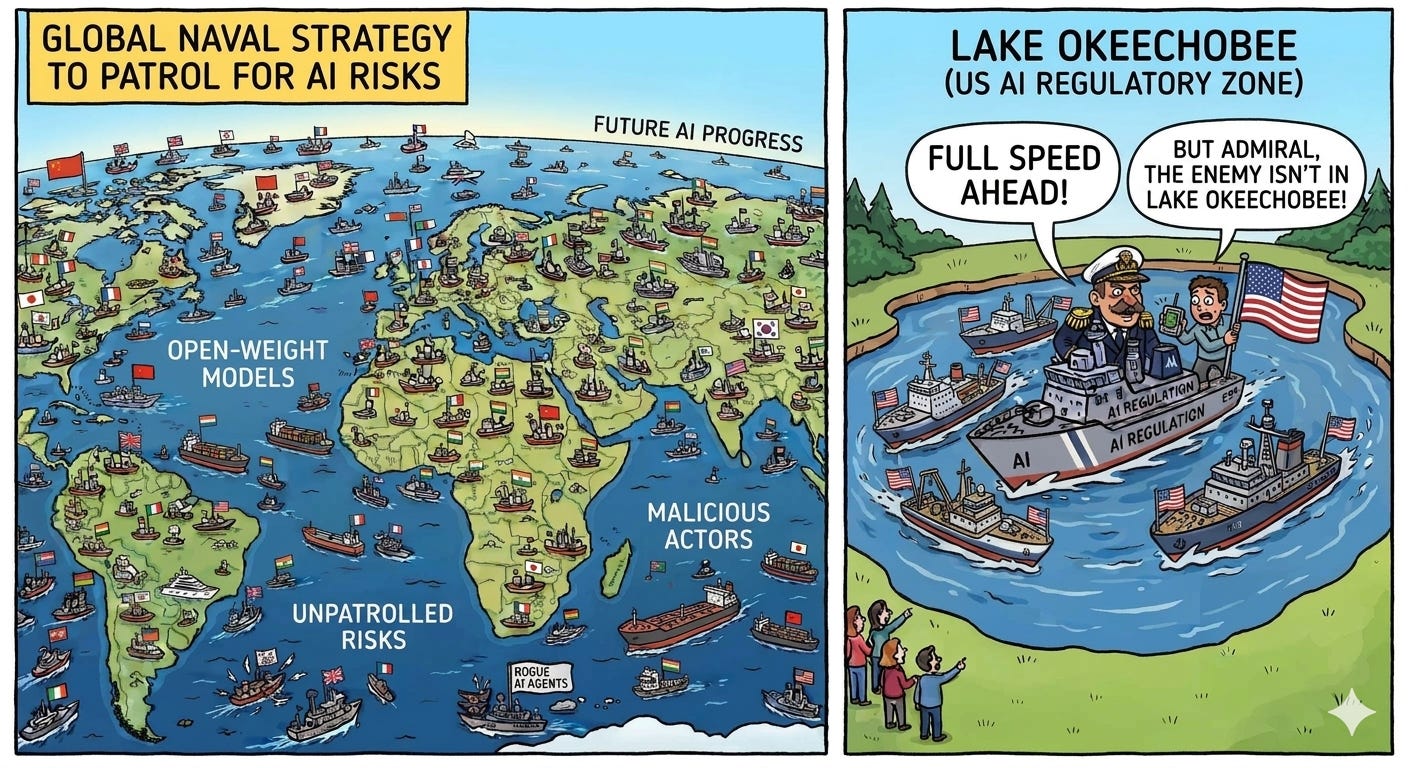
Concurrently, we must not hesitate to regulate American models, but overcoming the political barriers—on both sides of the aisle—to enact sensible AI regulation in Congress requires showing some likelihood of bringing Chinese AI under the same safety rules.
The China-U.S. Summit
Ten days ago, we witnessed the Trumpian spectacle of the U.S.-China summit. The participants reported little progress on AI safety, perhaps because many other contentious issues, such as trade, Taiwan, and the Iran War, consumed the attention of Trump and Xi. Yet little progress was expected; days before the summit, President Trump stayed “on brand” by asserting that the “United States of America is not going to be putting on brakes” on AI, and “[t]hey want to stop our progress because we’re leading China by a lot and we’re going to keep it that way.”
Nonetheless, some hopeful signs have emerged. Immediately prior to the summit, Treasury Secretary Scott Bessent pressed his Chinese counterpart to deploy “a red phone“ to improve the two superpowers’ reporting of incidents posing national security risks. It would be more helpful, of course, if we had some idea about what would make the “red phone” ring, but we have few details about how the countries would define the reportable risks. The White House also reported a joint commitment to pursue a “U.S.-China Super Intelligence Dialogue” to exchange views on risks and benefits related to AI, with the next exchange to occur by November 2026.
The good news is that we’re talking. But are the right people speaking?
The Importance of Track II Diplomacy
America’s top AI experts don’t work in the White House, the Commerce Department, or anywhere else in the federal government. The Administration deploys agency heads like Treasury Secretary Bessent to negotiate with Chinese counterparts on a technology about which their departments have little expertise, and Trump himself notoriously came to the September summit poorly prepared.
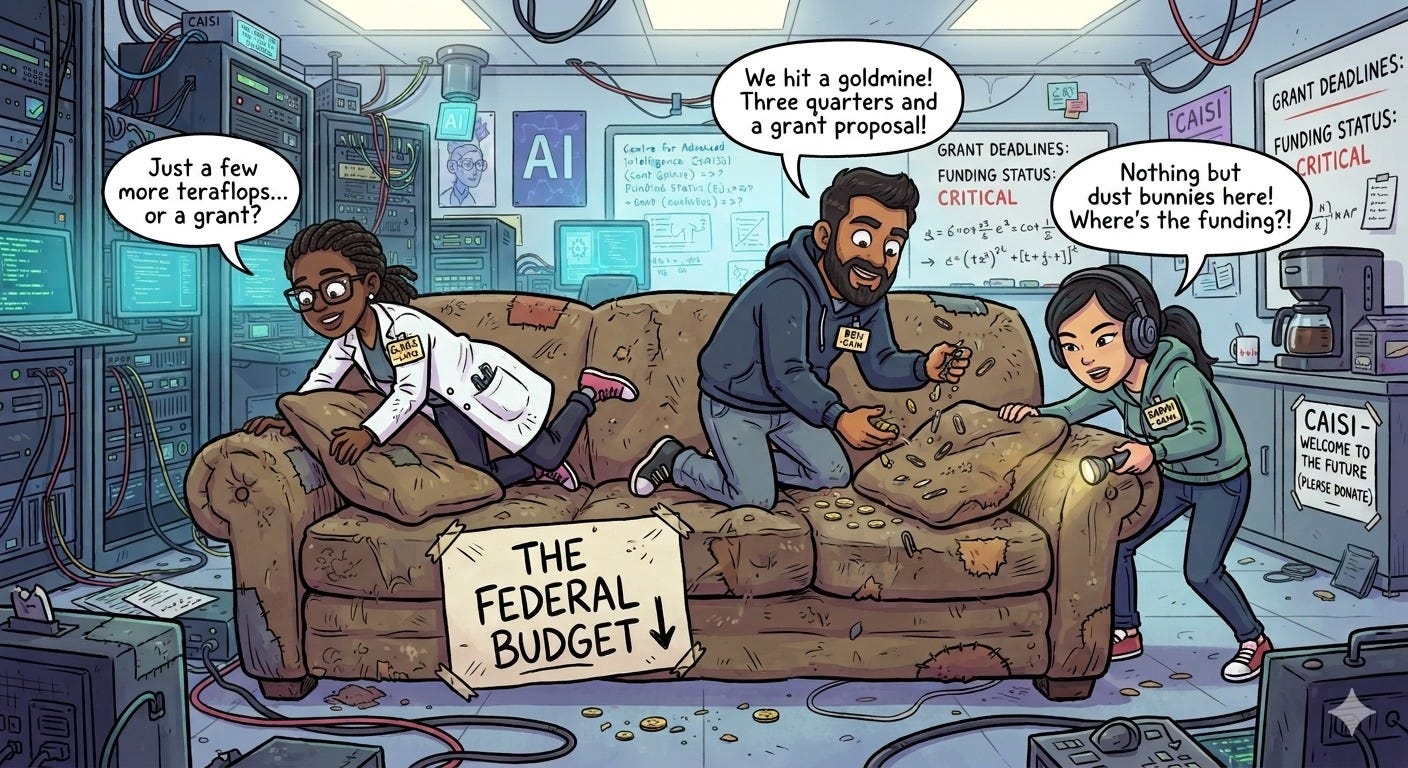
America’s top AI scientists work for the industry’s leading hyperscalers, in smaller AI startups, AI safety organizations, “swarm-chaser” shops, think tanks, and universities. The scarce federal AI expertise exists disproportionately concentrated in an understaffed Commerce Department agency, the Center for Artificial Intelligence Standards and Innovation (CAISI), with no regulatory authority, no congressional authorization, and seemingly little cachet in the White House. My colleagues would struggle to identify CAISI’s budget under a single data center’s couch cushion.
Many months of preparation—primarily technical discussions between experts—must precede any fruitful negotiation between political leaders. In nuclear disarmament negotiations, at gatherings such as the Pugwash Conference and Dartmouth Conference, Soviet and American scientists sought common understanding about how to assess and verify nuclear enrichment, weapons testing, and warhead counts. In the absence of this preparation—developing shared understanding between U.S. and Chinese AI experts about how to measure model capabilities, how to test for misalignment, or how to verify compute allocations, for example–little progress can occur at the negotiating table.
Discussions among non-governmental technical experts—“Track II diplomacy”—lay the groundwork for political agreement later. Track II discussions on AI safety do occur—in such forums as the International Dialogues on AI Safety (IDAIS), and the Brookings-Tsinghua dialogues—but they appear tightly constrained, and too disconnected from government-sanctioned diplomatic efforts.
Permission to Speak Freely
I’m told that those private-sector and academic experts often hesitate to speak about AI safety with their Chinese counterparts—or with each other—to avoid violating the law. Otherwise well-intended national security laws, antitrust rules, export restrictions, and other laws constrain what can be said, who can say it, and who can hear it. Compounding the challenge: this Administration’s demonstrated willingness to inflict politically motivated criminal prosecutions and retribution upon companies that express independent political viewpoints. Few companies or universities will risk criminal prosecution to engage with experts at Alibaba or Peking University about anything AI-related.
The legislation would authorize American academics, practitioners, and scientists who register with the State Department to engage Chinese peers on AI safety, while maintaining prohibitions on discussion that could compromise intellectual property, expose U.S. cyber vulnerabilities, or facilitate model distillation. It would create narrow exemptions from those prohibitions for registered U.S. AI safety experts, and integrate their work into official negotiations. Under limited circumstances, the law should also enable discussion between U.S. AI experts and the Cyberspace Administration of China (CAC) and its relevant subagencies like TC260 and WG9, because unlike the U.S., Beijing has regulatory experts with authority and experience within government.
Much preparatory work needs to get done for November’s meetings. This isn’t “amateur hour.” Political leaders in tense negotiations cannot improvise agreed-upon metrics for assessment, or shared definitions for RSI, or common testing methods for misalignment risk. It requires those with deep technical expertise to coolly engage, without the political pressure to reach a bad agreement.
Learning
There’s another important benefit to Track II diplomacy: we can learn something. AI poses regulatory challenges unlike any other technology, and neither Beijing nor Washington really understands how to regulate AI sufficiently to make it safe. The U.S. has virtually no regulatory experience at the federal level, and only limited experience in states like California and New York. Beijing, as noted, has years of it. Yet China’s AI safety testing ecosystem appears much less mature than ours; in contrast, many sophisticated American research groups publicly prevail upon companies to disclose adverse incidents, test and report misalignment, and the like.
Falling Short of Agreement
China hawks doubt that we can ever reach substantive agreement with China. To be sure, we should temper expectations; we won’t reach quick agreements of any consequence, and certainly not under an administration that views AI safety concerns as a “hoax.”
Yet enormous good—and substantial mitigation of risk—can come from Track II diplomacy long before any agreement is reached, or without agreement.
Game theory provides some insight here, as it did for generations of negotiators of nuclear nonproliferation and arms control deals. Getting the experts in both countries to understand how the other side measures model capability, assesses safeguards, determines misalignment risk, or verifies progress can become extremely valuable. Most importantly, both sides need to understand precisely where the other draws the “limits” about safety and model capability on the continuum to recursive self-improvement (RSI), because that perceived threshold will drive behavior.
A recent working paper by economists Drew Fudenberg at MIT and Andrew Koh at Columbia University models this dynamic: when rivals have more transparent and accurate views of each other’s capabilities and limits, it becomes far more likely to sustain mutual restraint. When capabilities remain hidden until deployment, the temptation to race prevails. Currently, China has no reason to believe that the U.S. will take AI safety seriously; Congress has never enacted any meaningful federal law on the topic, and our President mocks those who advocate for it. Track II dialogue—coupled with regulatory action in Congress and the Administration—can change that.
China’s Progress on AI Safety
Finally, we must not dismiss the very real opportunity for agreement between the two superpowers. Despite our intense competition with China, our incentives still overlap substantially.
Beijing’s motives, of course, often differ from Washington’s. Like any totalitarian regime, the Chinese Communist Party fears a loss of control, and AI threatens that control. China’s early regulation predictably focused on limiting the dissemination of information. A recent demonstration, in which researchers used AI to build a zero-click worm capable of recent experimental demonstrations of an AI agent hijacking accounts across WeChat’s platform of 1.4 billion users, shows how fragile those information controls have become. A September article by Chen Yixin, the head of China’s Ministry of State Security, displays Beijing’s fears about adversaries’ use of American frontier models to spy on the Chinese military, or to conduct attacks on critical infrastructure.
Increasingly, however, Beijing’s tone and focus have shifted. The most recent regulatory framework of the Cyberspace Administration of China (CAC) addresses rogue agents and cybersecurity risks. As top Chinese AI scientists, such as leading Tsinghua researchers Andrew Chi-Chih Yao and Zhang Ya-Qin, continue to advocate in a remarkably candid way about mitigating catastrophic risk, their advocacy has a growing impact on Beijing. For example, in a major address in July, President Xi articulated substantial concern about AI’s broader threats to humanity, and the imperative to take action.
These promising signs should have us redoubling our efforts. We have a long journey ahead, and starting has become more urgent than ever. We can begin by removing the barriers to our future progress, and accelerating discussions among AI safety experts.
Add your name: Tell Congress to advance the bill and demand that we pave the path to binding, verifiable AI safeguards with China, by signing up at this link.
Sam- you could have and a host of people in your position said the same about the internet when it was formed. Look at the havoc it's caused. It's also created a host of good.
Bob