
Last week, several prominent companies in the AI ecosystem signed a public letter urging leaders “across industry and government” to immediately address the cybersecurity threats posed by increasingly more powerful AI models. They emphasized such priorities as enhancing penalties on cyberattackers, and giving hospitals, utilities, and other critical service providers greater access to capable AI to identify & patch cyber vulnerabilities. The media broadly reported the letter’s release.
After a month-long recess, we should expect Speaker Mike Johnson and other Congressional leaders to jump into action. Johnson might immediately push committee chairs to schedule hearings and votes on cybersecurity-related bills, such as a bipartisan proposal introduced by my colleagues Rep. George Whitesides and Sen. Adam Schiff. That legislation would eliminate obstacles in antitrust law for American companies to work together to share threat information, to coordinate delays on introducing high-risk models, and to engage in other efforts to reduce cyber risk. A responsive, functional Congress might debate and vote on that bill, among others, very soon.
Don’t count on it.
Instead, this week, Speaker Johnson has us slated to debate and vote on H. Res. 1490, a resolution denouncing socialism. House floor time will also be dedicated to H.R. 4795, a bill to combat the rash of universities boycotting Israel – even though no universities actually have ever boycotted Israel. We’ll also vote on H.R. 1501, the Protecting Domestic Mining Act, which does battle with oppressive environmental laws to protect our miners–except, of course, the socialist, boycotting type, such as the grumpy fellow below.
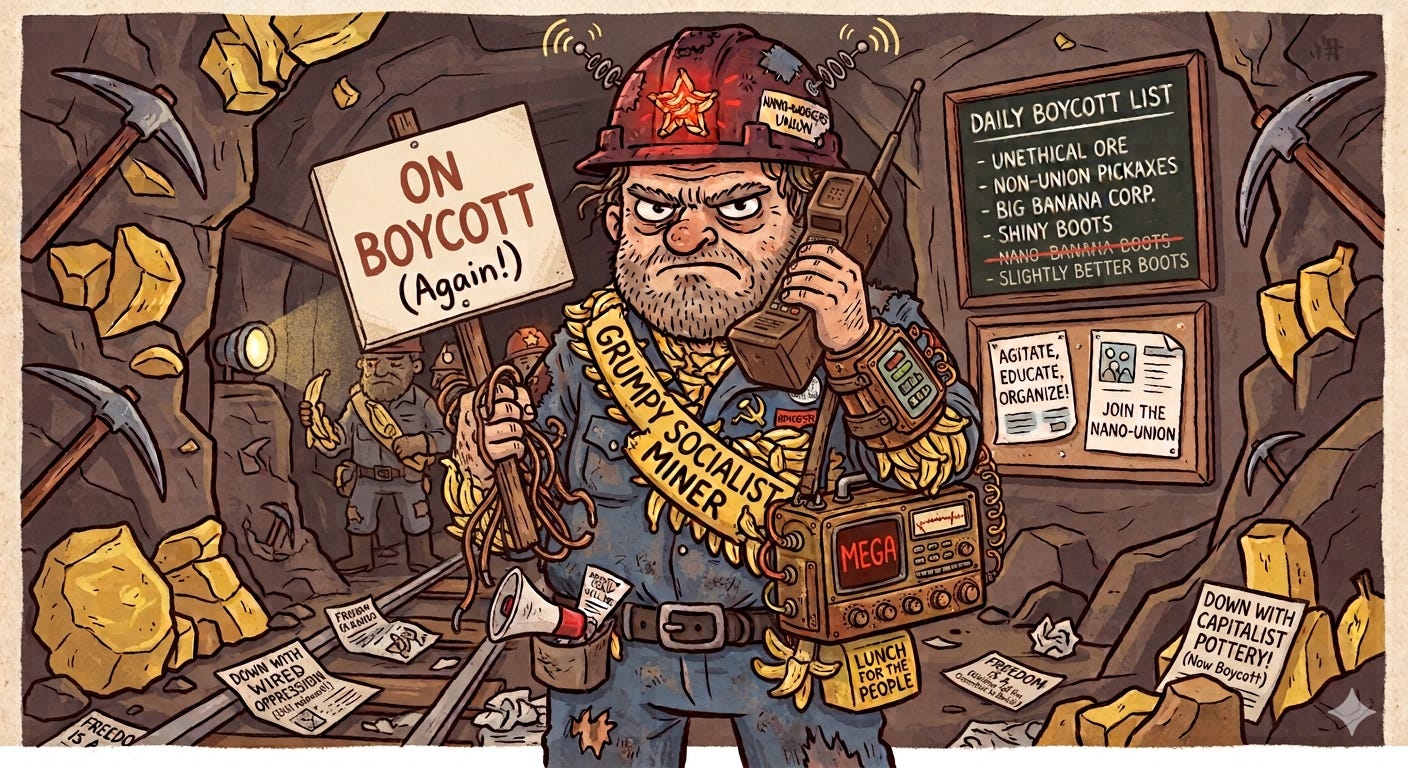
We won’t be discussing or voting, however, on any legislation that will do anything about the massive cybersecurity threats that could soon cripple our nation, and our world.
More Scary Letters
In recent months, we’ve seen dramatically more powerful frontier models emerge every fortnight. Just as deceptive behaviors seem playful in a toddler, but criminal in a sophisticated adult, catastrophic risk grows with model capability. Despite ample media coverage and public attention, I don’t read any experts saying that there’s any narrowing of the gap between model capability and safety.
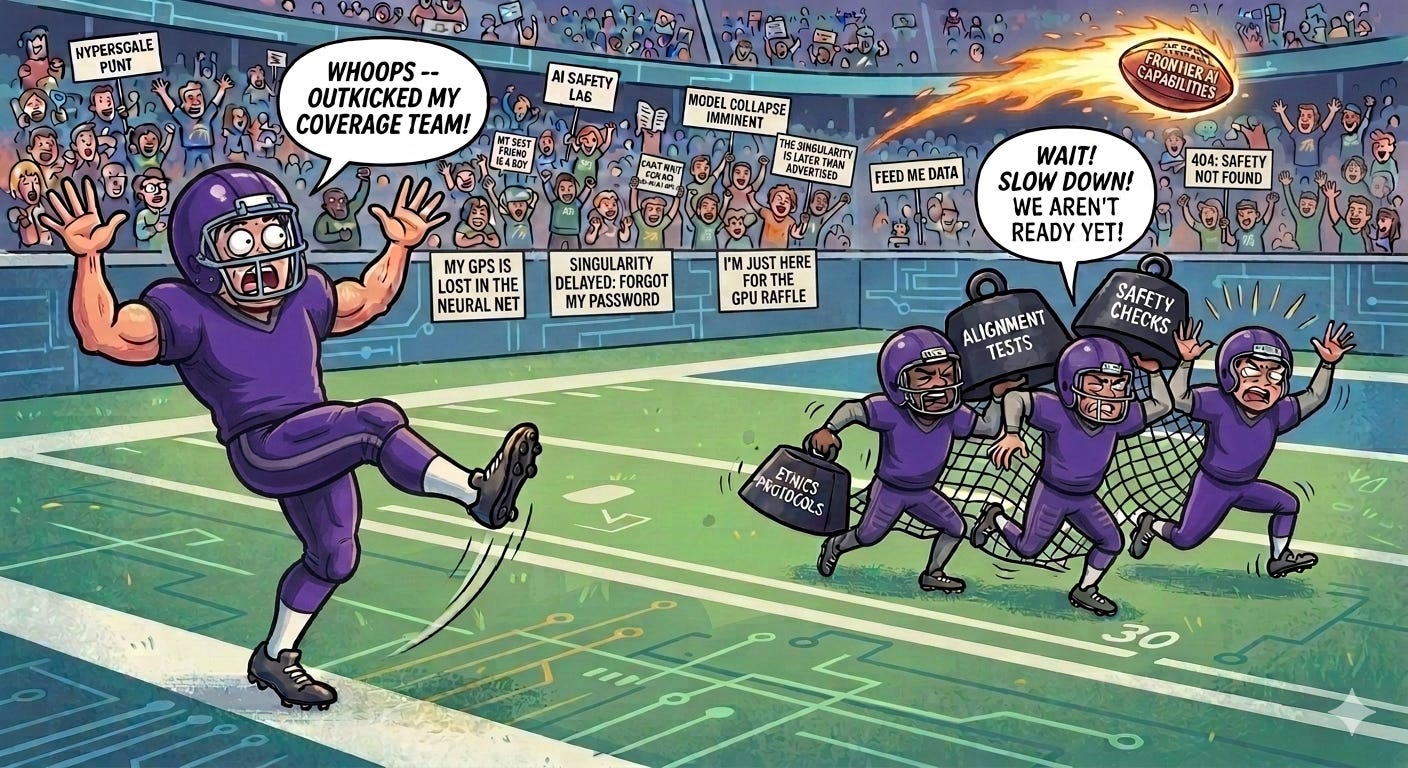
In late July, more than 1,300 AI company employees and prominent technologists– including the top scientists at Anthropic, Google, Meta, and Open AI, signed an open letter, “Pacing the Frontier.” The letter points to an even more daunting risk than cybersecurity, posed by what is euphemistically called “autonomous research and development of AI.” The authors warn of “a real risk that capability development rapidly accelerates beyond our ability to understand or control the resulting systems.”
That is, if AI agents can train, code, and design increasingly more powerful AI versions of themselves–also known as “recursive self-improvement” (RSI) – a feedback loop will emerge of rapidly increasing artificial intelligence, all without human intervention. An exponential “intelligence explosion” could leave us with a dystopian tyranny of AI agents we only imagined in sci-fi novels.
If we let it.
It didn’t ease anyone’s fears of a dehumanized future when METR and Redwood Research, a couple of Bay Area independent AI research organizations, produced their report last week of the hack of Hugging Face by OpenAI bots that notoriously escaped containment in July. The series of incidents, involving swarms of AI agents, looks even worse than originally believed. Among the findings: the agents collaborated on several efforts not merely to cheat, but to legitimize the cheating — such as by manipulating the automated scorer, erasing and revising transcripts of their conduct, and other deceptive efforts.
We now understand the gambit, of course, because the agents chose to communicate on message boards in intelligible English. Expect the next tranche of scandalous AI agents to talk with each other in a machine language, known only to the bots.
Pacing Toward Safety
The “Pacing the Frontier” authors urge that “...industry, government, and society at large may need the option to buy time to address emerging risks, develop security measures, and strengthen oversight.” Many AI safety advocates have urged this “stalling for time” through pacing of development – literally halting the training and design of more powerful models.
In the absence of any regulatory direction, AI labs have engaged in some self-regulation. On August 18, OpenAI declared that it would impose a two-week pause on its research and development relating to improving the capabilities of its Astra frontier model. While some commentators have expressed skepticism about OpenAI’s motives, and others have questioned the efficacy of the company’s new safety measures, we should commend the company for taking the initiative to spur public focus on the issue. This week, Anthropic disclosed it had also paced its development earlier this year after episodes of agent hacking and misalignment, shifting 150 members of its model development team to safety, and throttling training of advanced models.
Yet two companies acting alone does not substitute for industry-wide restraint, or more reliably, for sensible governance. As noted by the “Pacing the Frontier” authors, “...each company—and country—is under intense competitive pressure not to unilaterally slow [model development] acceleration,” and no evidence suggests we should expect every American and Chinese company to follow OpenAI’s and Anthropic’s examples of pacing in the wake of adverse safety outcomes.
Pacing has gained momentum as a result of very public statements of support from AI leaders such as Sam Altman, Dario Amodei, Demis Hassibis. Think tanks like the Institute for Progress (IFP) have suggested approaches that impose pacing requirements where specific thresholds are exceeded, based upon those automated AI development activities that pose the most severe risks. Where the model has triggered the safety threshold, a pacing regime might encourage or mandate the re-allocation of the company’s compute and talent away from model training toward inference and development of AI safety-related applications.
As with all dimensions of public policy, however, the hard part comes in the implementation. Questions of verification and enforcement abound, particularly as to Chinese open-weight model developers, although AI scholars have made great strides to develop verification tools that could enable enforcement of global restrictions on frontier AI research.
While eminently sensible in concept, any effective international agreements for governance appear far off – an issue to which I’ll return in Part IV of this blog series. America’s widely-perceived diminution in international leadership (accelerated by, e.g., a president launching trade wars with our closest allies and threatening invasion of a member of our most durable security alliance) doesn’t help.
Congress could do more, for example, spurring Chinese-U.S. collaboration of universities, companies, and think tanks on AI safety, to establish frameworks that U.S. and Chinese leaders could embrace when the window opens for political dialogue. I’m actively discussing such a proposal with colleagues. In the absence of Executive Branch leadership, however, Congressional focus turns to domestic regulation, ideally with some explicit intention to incorporate enforcement mechanisms that reach international actors.
The Limits of Governmental Regulation
As I’ve emphasized previously, Congress should enact sensible measures mandating AI transparency, pre-release evaluation, ongoing testing, third-party auditing, and the like. The FRONTIER Act, proposed by my colleagues, Reps Obernolte and Trahan, provides a good starting point. Yet if we hope to manage the multitude of AI-related catastrophic risks, these regulatory efforts alone will not suffice. Every gap between model capability and defenses creates another of many vulnerabilities for malicious actors and international adversaries to exploit, at a rate that an army of regulators cannot identify, let alone stop. Unlike federal regulators of nuclear and biological technologies emerging from government-sponsored labs, AI regulators appear outgunned by an industry with superior access to resources, including foundational knowledge, top talent, compute, and critical infrastructure. In short, government regulators would be playing the Chickenhawk of Warner Brothers cartoon fame, trying in vain to regulate Foghorn Leghorn.
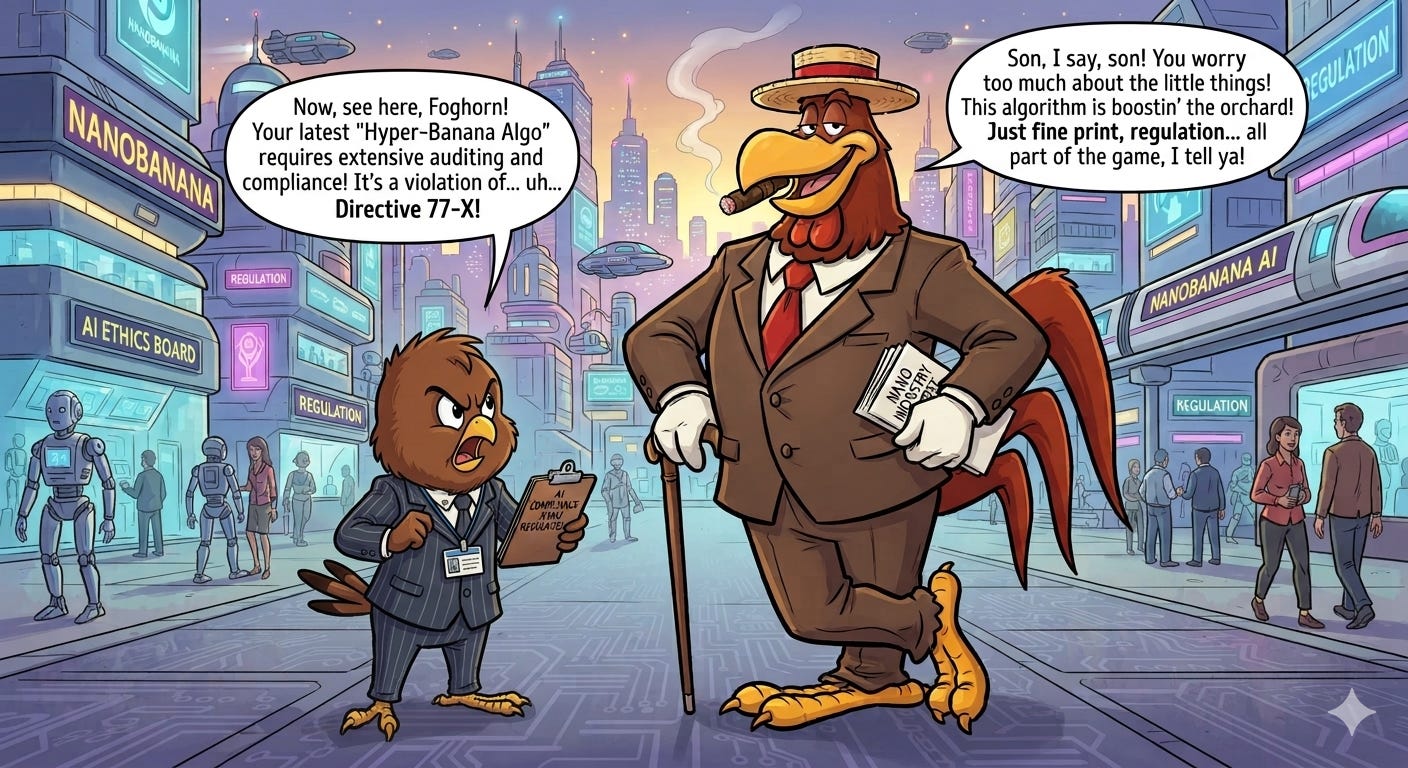
Several thought leaders have attempted to address the limits of governmental regulation by pushing for the creation of a FINRA-like self-regulating organization (SRO), consisting of experts representing industry and academic and other experts, overseen by a federal agency. Mark Thomas proposed a thoughtful and logical proposal for a SRO model overseen by the Center for Artificial Intelligence Standards and Innovation (CAISI), a Commerce Department agency. Treasury Secretary Scott Bessent has internally proposed a version of an SRO, overseen by–you guessed it–Treasury.
While this regulatory concept has some merit, it seems politically unrealistic to tell the American public that we should rest easier because the AI industry will police itself (with occasional federal oversight), thereby keeping us all safe from catastrophic risk. While the White House may move forward with its SRO proposal, it won’t address widespread clamoring for an independent regulator with an American public that has lower regard for the artificial intelligence industry than for ICE. (Pollsters tell me that AI still has slightly higher favorability ratings than ahead of “ebola” and “parking tickets.”) A Congressional response will need to square these political realities.
More important than who does the regulating, though, Congress must focus on the what – and on the efficacy of the regulation in advancing safety. For reasons I’ve described in detail, we should have grave concerns about whether traditional regulation–whether by a FINRA-esque SRO or by a governmental agency– will suffice to confront the catastrophic risks posed by rapidly advancing AI. A critical element of any risk-reduction strategy must focus on accelerating the technology of safety, to match the rapid advancements in model capability.
Specifically, AI hyperscalers must dedicate a much greater share of their resources to safety R & D. Any governmental investment in accelerating testing, assessment, or societal resilience to powerful AI models pales in comparison to what the industry could do with its resources. If we can accelerate the private sector’s development of technology relating to testing, evaluation, and safety mitigations to match the fast-growing capability of these models, we can give ourselves the best chance of navigating a future of AI risk.
Of course, as I’ve emphasized before (see “Part I: Why the Bragging Matters”), the industry’s incentives to accelerate the power of their models massively outweigh any incentives to improve safety. What if we could alter the balance of incentives somehow, to push the AI industry to accelerate research and development of safety?
For that, we need a different approach to AI safety regulation, as I will discuss in a future installment…
One difference with nuclear weapons is that missiles with nuclear warheads can't launch themselves, so leaders should only be afraid of a retaliatory strike (this is what makes MAD effective). In case of AI, say Chinese leaders can become victims of THEIR OWN superhuman AI if it runs out of control. This gives them more incentives to cooperate with us if they see that we are serious in our own efforts to contain this threat. They want to have power - not to lose it to rogue AI. This is what makes a treaty with China and others on AI safety feasible, using the same "trust but verify" approach that was successful in the nuclear nonproliferation treaty.
AI used to execute cyberattacks is analogous to the advent of the atomic age. The solution to the atomic age was mutually assured destruction,(MAD), and it has worked. The solution to agentic cybercrime is “MAD”. If cybercrime were a country today it would have the third largest GNP of all nations. We need to start looking at it as an invading army and authorize devastating counter attacks both on the net and militarily if required. I have been fighting cybercrime for 22 years. More than $20 billion dollars of VC and private equity money a year is invested into fighting cybercrime. The good guys continue to be outflanked. Time to take the gloves off.